APPLICATION NOTE · PC · PROCESSING
Transparent PC Modification for Improved Processing Color Stability
An additive-selection approach to managing yellowing in transparent PC with Antioxidants 1010 + 168 and an optional PC anti-yellowing agent for residual color correction.
THE CUSTOMER CHALLENGE
When transparent PC develops a yellow cast.
A customer processing transparent polycarbonate reported a noticeable yellowish appearance in the finished product. For a transparent material, even a slight color shift can affect visual consistency and acceptance.
SCOChemical proposed evaluating Antioxidants 1010 + 168 to support processing stability, followed by a PC-compatible anti-yellowing agent if a slight yellow cast remained. The approach combines material stabilization with targeted optical color correction.
This application note describes the proposed approach. No measured before-and-after results or validated additive dosages were provided.
MATERIAL MODIFICATION
Stabilize the material before correcting its color.
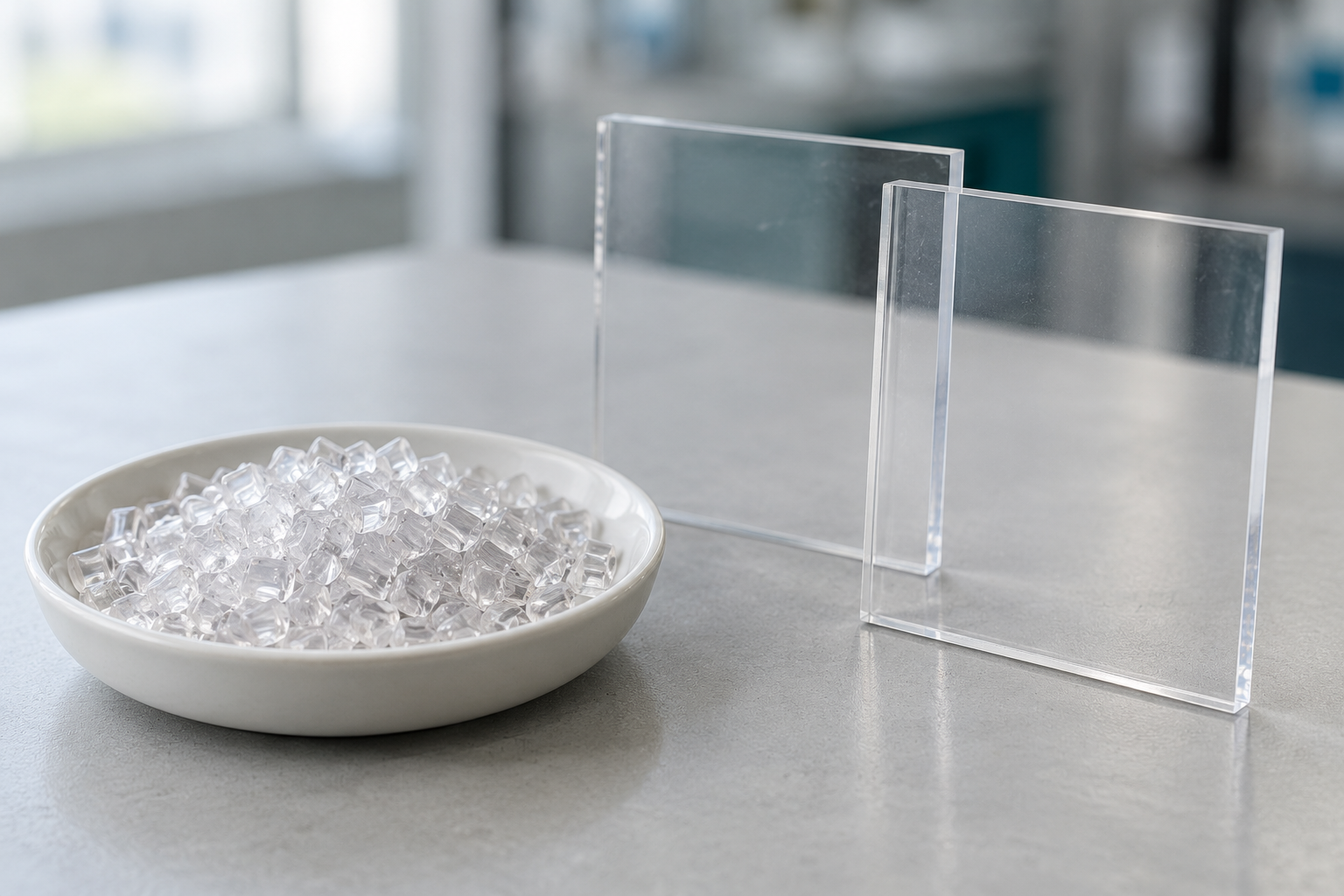
For a compounder, the task is to incorporate a suitable additive package into PC while retaining the optical and processing properties required downstream.
Evaluate the modified pellets and molded test plaques together. Clearer-looking samples alone do not establish that degradation has been controlled.
FEATURED ADDITIVE SYSTEM
⭐ Antioxidant 1010 + 168
Antioxidant 1010 is a hindered phenolic primary antioxidant. Antioxidant 168 is a phosphite secondary antioxidant used for processing stabilization. Their complementary functions make the combination a candidate for evaluating thermo-oxidative stability.
The pair is not a universal solution for every transparent PC grade. Suitability depends on the resin’s existing stabilizer package, additive purity, compatibility and processing conditions. Selection must also account for clarity and haze.
Process checks: Confirm drying and residual moisture against the resin supplier’s guidance, then review actual melt temperature, residence time, shear and material history alongside the additive trials.
| Additive candidate | Role in this approach | What to evaluate |
|---|---|---|
| ⭐ Antioxidant 1010 | Primary antioxidant candidate for thermo-oxidative stabilization. | Processing color retention, compatibility and optical properties in the selected PC grade. |
| ⭐ Antioxidant 168 | Secondary antioxidant candidate to complement the primary antioxidant during processing. | Performance of the combined package under actual thermal and processing conditions. |
| PC Anti-yellowing Agent — optional Blue/violet color-correction type | Optical compensation for a slight residual yellow cast after stabilization and process optimization. | Color balance, light transmission, haze, dispersion and heat stability. |
RESIDUAL YELLOWING CONTROL
PC Anti-yellowing Agent.
Targeted color correction for a clearer, more neutral appearance.
If a slight yellow cast remains after stabilization and process optimization, evaluate a PC-compatible anti-yellowing agent based on a suitable blue/violet color-correction system. This is the optional color-adjustment component in the additive table above.
Here, the anti-yellowing agent is an optical color corrector: it compensates for a residual yellow tone. Antioxidants 1010 + 168 address processing stabilization; the color corrector adjusts appearance. Optical correction does not reverse polymer degradation or restore lost mechanical properties.
Select a grade intended for transparent PC and its actual processing temperature. Establish a controlled, low addition level and uniform dispersion through trials, checking yellowness index or color coordinates together with light transmission and haze. Excessive addition may introduce a blue/violet cast or reduce light transmission.
CONTROLLED EVALUATION
Compare like-for-like samples.
Keep resin grade, plaque thickness, molding conditions and measurement setup consistent when assessing changes.
- Baseline: document the current formulation, material history and processing conditions.
- Stabilized compound: compare the candidate 1010 + 168 package under matched conditions, recording any deliberate process changes separately.
- Color-adjusted compound: evaluate the PC anti-yellowing agent only if the stabilized material still needs residual yellow-tone correction.
Assess yellowness index (YI) and/or color coordinates, total light transmission and haze. Where degradation is a concern, also assess melt flow and relevant mechanical properties rather than accepting the compound on appearance alone.
APPLICATION SUPPORT
Discuss your transparent PC color-stability challenge.
Share your PC grade, existing additive package, drying and processing conditions, sample thickness and color requirements. SCOChemical can help discuss Antioxidants 1010 + 168 and whether a PC anti-yellowing agent is appropriate for residual color correction.
Discuss Your Application →