
APPLICATION NOTE · PC/ABS · ELECTRICAL & ELECTRONICS
PC/ABS Flame-Retardant Modification for Charger Housings
A reference formulation approach to balancing flame retardancy, heat resistance and impact performance in compact injection-moulded enclosures.
THE MATERIAL TARGET
From PC/ABS base resins to flame-retardant pellets.
This application note focuses on the modification of PC/ABS base resins into flame-retardant pellets for downstream injection moulding.
The featured flame-retardant route combines TBPC with Sb₂O₃ MB as a bromine–antimony system for evaluation in modified PC/ABS pellets. TBPC provides the brominated flame retardant; Sb₂O₃ MB supplies the antimony trioxide synergist. SMA remains a supporting candidate where blend compatibility needs improvement. Product grade, masterbatch carrier and additive balance must suit the selected PC/ABS system.
DOWNSTREAM APPLICATION
Modified material for electrical housings.
Base resin → compounding → pellets
PC and ABS base resins are melt-compounded with the selected additives and pelletised. The modified pellets are then used by downstream processors to injection-mould housings.
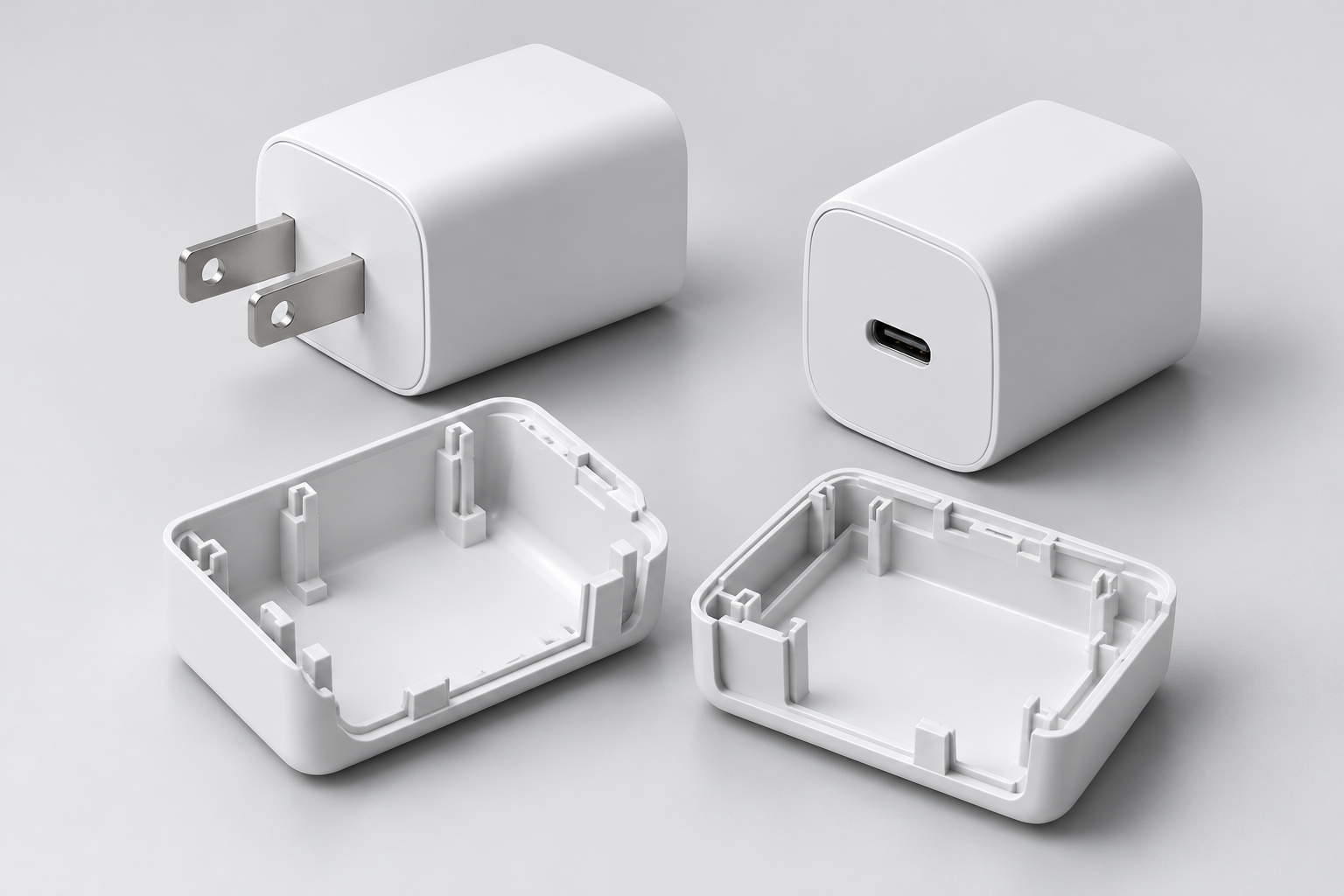
Housing features such as openings, snap fits and thin walls provide downstream validation conditions. This note focuses on the modified compound and its additive selection.
REFERENCE FORMULATION
Reference formulation and product selection.
The original formulation is retained as a development reference. The product column identifies candidates from SCOChemical’s portfolio; it does not mean these products were specified or tested in the original formulation.
| Ingredient | Original amount (parts by mass) | SCOChemical product candidate for evaluation | Function |
|---|---|---|---|
| PC | 70 | Application-specific PC grade | Base resin |
| ABS | 30 | Application-specific ABS grade | Base resin |
| Compatibiliser | 5–10 | SMA Compatibiliser — TTMA | Evaluate blend compatibility and delamination |
| Flame retardant | 20–30 | ⭐ TBPC + Sb₂O₃ MB | Brominated flame retardant plus antimony trioxide synergist; establish the ratio and carrier suitability for PC/ABS |
| Light stabiliser | 1.0 | Select according to exposure conditions | Support light stability where required |
| Processing aid | 1–2 | Select according to processing requirements | Address the identified processing requirement |
| Other additives | As required | Select for the identified material requirement | Additional functions as required |
FEATURED FLAME-RETARDANT SYSTEM
⭐ TBPC + Sb₂O₃ MB.
A bromine–antimony route for evaluating flame-retardant modification of PC/ABS.
TBPC, or Tris(Tribromophenoxy)-s-Triazine, is a brominated triazine flame retardant supplied as a white powder. In this development route, it is evaluated together with Sb₂O₃ MB, a pelletised antimony trioxide masterbatch. Antimony trioxide acts as a synergist with halogenated flame retardants; the complete package must be evaluated in the selected resin blend.
For charger and adapter housings, assess the TBPC/Sb₂O₃ balance against the required flame performance while monitoring impact strength, heat resistance and melt flow. Meter the TBPC powder and Sb₂O₃ masterbatch consistently and check dispersion in the compounded pellets.
SCOChemical’s Sb₂O₃ MB page lists an EVA / Universal carrier and formulation-dependent dosage; it does not specify the active Sb₂O₃ concentration or explicitly list PC/ABS. Confirm a carrier and grade suitable for the intended PC/ABS processing conditions before trials. Masterbatch mass is not the same as active Sb₂O₃ mass.
- Test flame performance at the required specimen thickness.
- Confirm the masterbatch’s active content and carrier suitability, then check heat resistance and dispersion.
- Compare impact strength and melt flow with the base compound.
The original table describes formulation structure. The TBPC/Sb₂O₃ MB ratio, total addition and any anti-drip requirement must be established through trials rather than inferred from its generic flame-retardant range.
SUPPORTING ADDITIVE
SMA TTMA for blend compatibility.
A compatibiliser candidate corresponding to the compatibiliser row in the reference table.
SCOChemical’s SMA compatibiliser portfolio includes TTMA, listed for PC/ABS and other polymer blends with compatibility and delamination concerns.
Its role here is specific: evaluate whether it improves blend compatibility where phase separation or delamination is observed. Compare compounds with and without SMA, checking delamination, impact performance and melt flow, then recheck the flame and thermal properties of the complete formulation.
SMA is not a substitute for a dedicated toughening additive. If impact performance remains below target, TT37 from the PC/ABS toughening series is an additional candidate to evaluate. It is not identified as an ingredient in the original formulation, and its effect on toughness, flame performance and heat resistance must be verified.
View SMA Compatibiliser →MODIFIED PELLET EVALUATION
Assess the compound before the housing.
Evaluate the TBPC/Sb₂O₃ MB package in the modified pellets, then assess each supporting additive.
Dry the base resins according to their suppliers’ requirements. Confirm the Sb₂O₃ MB carrier, active content and processing limits; establish consistent feeding of TBPC powder and masterbatch pellets, and control melt temperature, residence time and mixing. Check dispersion and pellet consistency, then mould specimens to assess flame performance, impact strength, heat resistance and melt flow.
If UL 94 V-0 is required, test the final compound at the specified thickness, colour and conditioning. The choice of TBPC, Sb₂O₃ MB, SMA or TT37 does not establish a V-0 result by itself. Confirm any anti-drip requirement and assess the final formulation at the specified test conditions.
After material testing, use the modified pellets to mould representative housings and assess filling, assembly, drop behaviour and thermal deformation against the customer’s requirements.
RELATED PRODUCTS
Products to evaluate in this modification route.
⭐ TBPC
Brominated triazine flame retardant to evaluate with an antimony trioxide synergist in the selected PC/ABS formulation.
Explore TBPC →Sb₂O₃ MB
Antimony trioxide masterbatch for the synergist component. Confirm active content and a carrier suitable for PC/ABS before evaluation.
View Sb₂O₃ MB →SMA — TTMA
Compatibiliser candidate for assessing PC/ABS blend compatibility and delamination.
View SMA Compatibiliser →Discuss your PC/ABS flame-retardant modification project.
Share your base resin grades, required flame classification, test thickness and current material challenge. SCOChemical can help assess TBPC, a suitable Sb₂O₃ masterbatch grade and supporting additives for evaluation in your modified PC/ABS pellets.