
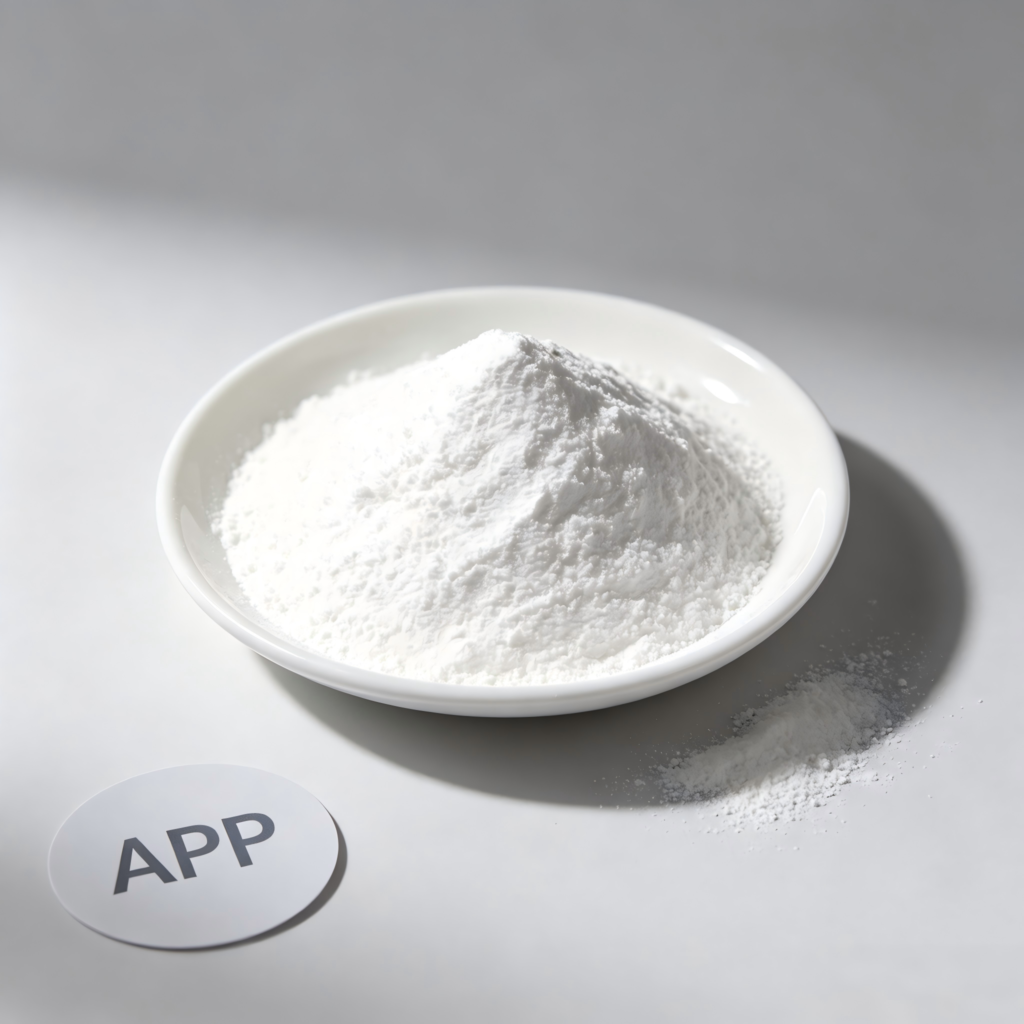
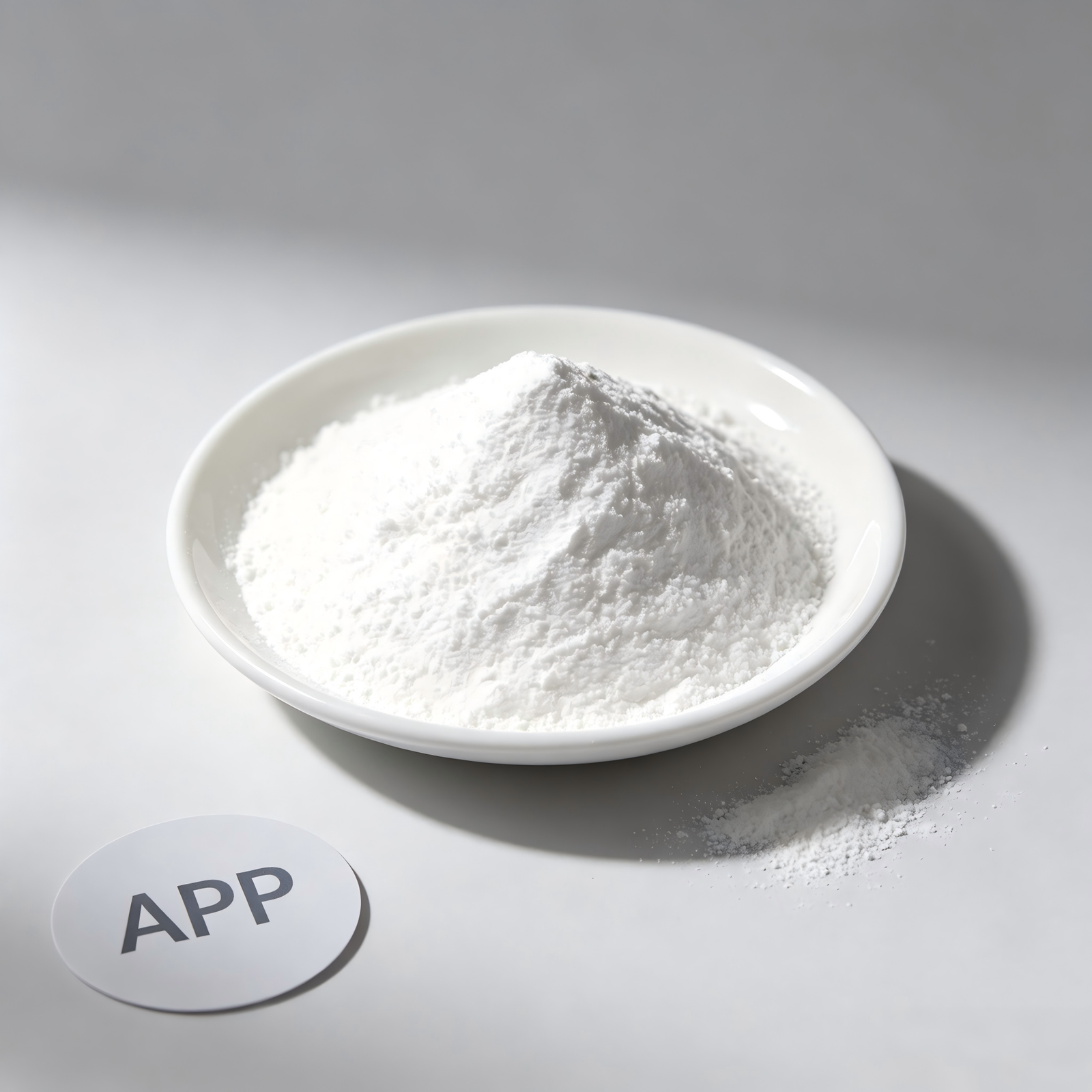
Ammonium Polyphosphate
Formula: (NH₄)(n+2)PnO(3n+1)
CAS No.: 68333-79-9
APP (Ammonium Polyphosphate)
APP is a polymeric form of ammonium phosphate and a halogen-free phosphorus-nitrogen flame retardant. Its performance is determined by its degree of polymerization and crystal structure, which affect water solubility and thermal stability.
Product Highlights
- Halogen-free phosphorus-nitrogen flame-retardant system.
- Available in water-soluble, water-insoluble and high-polymerization-degree forms.
- APP II crystalline products provide strong hydrolysis resistance and thermal stability.
- Suitable for plastics, coatings and composite materials.
- Low hygroscopicity supports processing and storage stability.
CLASSIFICATION BY DEGREE OF POLYMERIZATION
| Type | Degree of Polymerization | Core Characteristics | Typical Applications |
|---|---|---|---|
| Water-soluble APP | 10–20 | Short chain; high water solubility and lower thermal stability | Forest-fire extinguishing agents and early-stage fertilizers |
| Water-insoluble APP | n > 20 | Lower water solubility and improved stability | Plastics, coatings and composite materials |
| High-polymerization-degree APP | n > 1000 | Low water solubility and stronger thermal and storage stability | Industrial flame retardancy for plastics and coatings |
CLASSIFICATION BY CRYSTAL STRUCTURE
Crystalline APP: APP II is the representative form. Its degree of polymerization is generally above 1000, with strong hydrolysis resistance and thermal stability. Its thermal decomposition temperature is above 300°C.
Amorphous APP: These products generally have a degree of polymerization below 100. Their loose structure and lower thermal stability make them suitable for simple extinguishing agents and other lower-demand applications.
TECHNICAL SPECIFICATIONS
| Item | Typical Indicator | Description |
|---|---|---|
| Appearance | White crystalline or amorphous powder | Odorless and easy to mix |
| Whiteness | ≥88% | Influences product appearance |
| Particle Size | Approximately 15 μm | Influences viscosity, dispersion and agglomeration |
| Phosphorus Content | 30–32% as P | Provides the acid source for flame retardancy |
| Nitrogen Content | 14–16% as N | Assists flame retardancy through inert-gas formation |
| Thermal Decomposition Temperature | APP I: approximately 150°C; APP II: >300°C | High-polymerization-degree products tolerate higher processing temperatures |
| Water Solubility | Below 0.5% for basic market-grade products | Can be reduced by higher polymerization or coating treatment |
| Hygroscopicity | Low | Supports processing and storage stability |
SAFETY AND ENVIRONMENTAL PROFILE
- Low toxicity: the stated rat oral LD₅₀ is greater than 10 g/kg.
- It does not release hydrogen halides during combustion; ammonia and other gases may be released.
- The provided information states compliance with EU RoHS, REACH and UL 94 V-0 requirements.
Regulatory status, test results and suitability for a specific export product should be verified against current certificates and technical documentation.